
Music has always been deeply influenced by technology. From the invention of new instruments to recording techniques, amplification, synthesizers, samplers, and digital audio workstations, technological shifts have repeatedly reshaped how music is created and consumed. This is particularly true over the last forty years or so. Nothing to do with technology and languages? Bear with me for a moment.
When I started hearing about AI tools capable of producing music, I felt compelled to try them out myself. If nothing else, experimenting seemed the only honest way to understand what these systems can really do. And, as usual, forming an opinion by doing and thinking through experience felt more meaningful than reacting from a distance.
What I discovered is, frankly, mind-boggling. Today, AI music tools offer an entire palette of possibilities. From a simple prompt-to-track approach (you can describe what you want in one or two sentences, and with a click of a button, new music is generated) to creative work with the AI: shaping the result, iterating, refining. You can provide lyrics (which strongly influence melody and structure), describe instruments, mood, tempo, arrangement, and even formal aspects such as verse–chorus structure. And of course, just like any musician today, you can post-produce the result, exporting stems, mixing tracks, adjusting balances, adding beats, and polishing the final sound. It all depends on the app, your artistic abilities, and your goals.
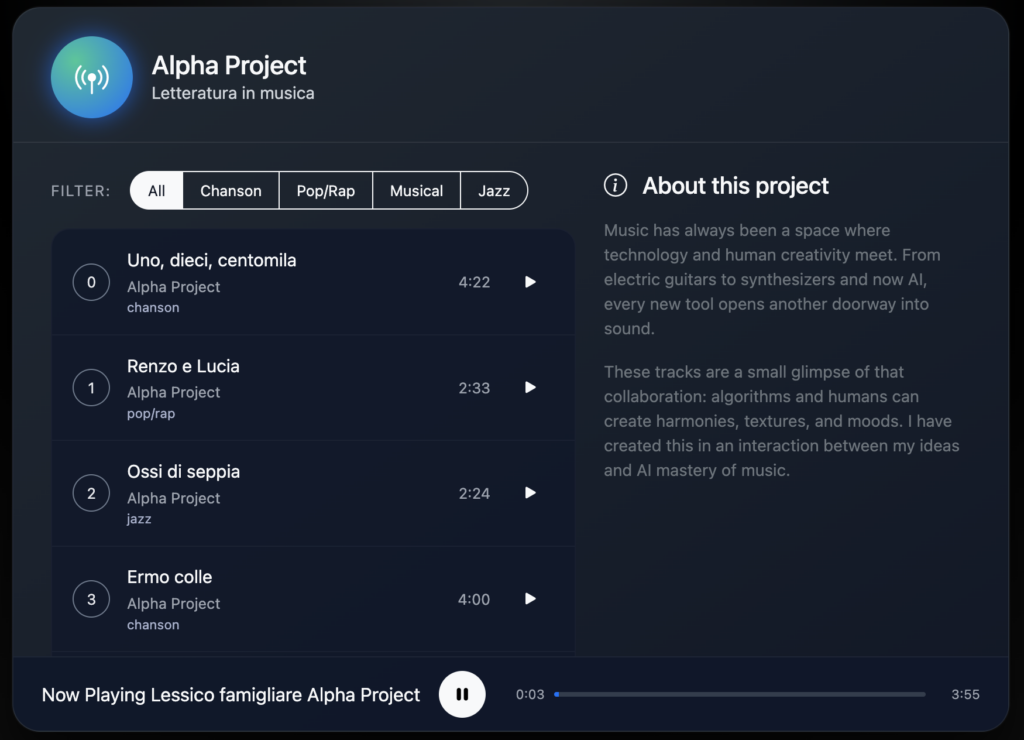
After some initial experimentation, I decided it was time to become a bit creative. I set myself a small project: to produce a concept album, named without any inspirational mood “The Alpha Project”, inspired by the leitmotifs and characters of Italian literature. Obviously in Italian and exploring the widest possible range of musical styles. For this project, I skipped the one-click-approach described above and put some effort in designing the concept album myself. While most tracks are in a typical Italian music style, I also deliberately experimented with stylistic blends and hybrid genres (Italian blues?). The result is available in a simple online player (which, incidentally, was also created with the help of AI). To be clear: this concept album is the result of quite heavily pre-processing (concept, lyrics, genre design and so forth), but no post-editing. You can access to the songs: HERE.
What follows are some thoughts after weeks of experimenting. I won’t go into musical analysis here. That’s not particularly interesting for the points I want to make.
1. The quality is astonishing
Independently of whether you like a specific genre or track, the quality of the output is remarkable. If you talk to artists willing, for a moment, to suspend the ethical and professional dilemmas posed by this technology, they will tell you how extraordinary it feels. The idea that a machine can generate such complex harmonies, structures, arrangements, and vocal performances in a complete autonomous way or through Human-Maschine interactions is still hard to fully process. If I hadn’t seen this happen myself, I would probably have said that this level of complexity was close to impossible to automate.
Side note: This is not like generating written text, which — however impressive — remains a relatively flat, one-dimensional output. Music is multidimensional: harmony, melody, rhythm, timbre, voice, structure, dynamics. The fact that all these layers can be coherently produced together in one click (prompt-to-track approach) is genuinely striking.
2. “Average” AI music is as good as “average” human music
There is probably no Beatles music coming out of this technology (or to align to the Italian focus of my concept album: no De Andrè, Battiato or Paolo Conte). However, much of what AI produces without heavy user intervention (prompt-to-track approach) is not worse than what has been produced by humans for years and regularly fills radio stations, playlists, and festivals. Yes, this comparison applies mostly to commercial and often stereotyped music, but that is precisely the kind of music consumed by the broadest segment of the population (but I am not so sure we cannot apply it to more sofisticated genres too). This alone should give us pause. Potentially, radios and streaming might be overflown by this one-click music. Actually they already have, as news outlets let us know.
3. Value lies more in attribution than in output
What we often call creativity, and what we assign value to, may have less to do with the artifact itself and more with the producer and the consumer. Most of the music we listen doesn’t have value intrinsically (the music is good because of itself): a track matters because its story, the intention behind it, the narrative that brought it to us. Someone who may have suffered, struggled, invested time, translated personal experience into sound. The fact that music is a product of its time, has created expectations and a mood, or it is simply part of a narrative created by the music labels to sell it. Value, in this sense, is relational and symbolic. And this is crucial. If it comes from a machine at a click of a button, it simply does have any of the above, and adding value might became a very complex operation.
4. AI music will be used by creative people
We like to think of creativity as something almost mystical, something deeply human and inaccessible to machines. But AI models can generate what we readily label as “creative” output, at scale. While I agree that we should first define creativity to be more precise, we might agree that these tracks are creative in their own right, if we simply compare with the mass production of music we have heard prior to AI. Will AI kill human creativity, as detractors continue to tell us? Possible, but improbable
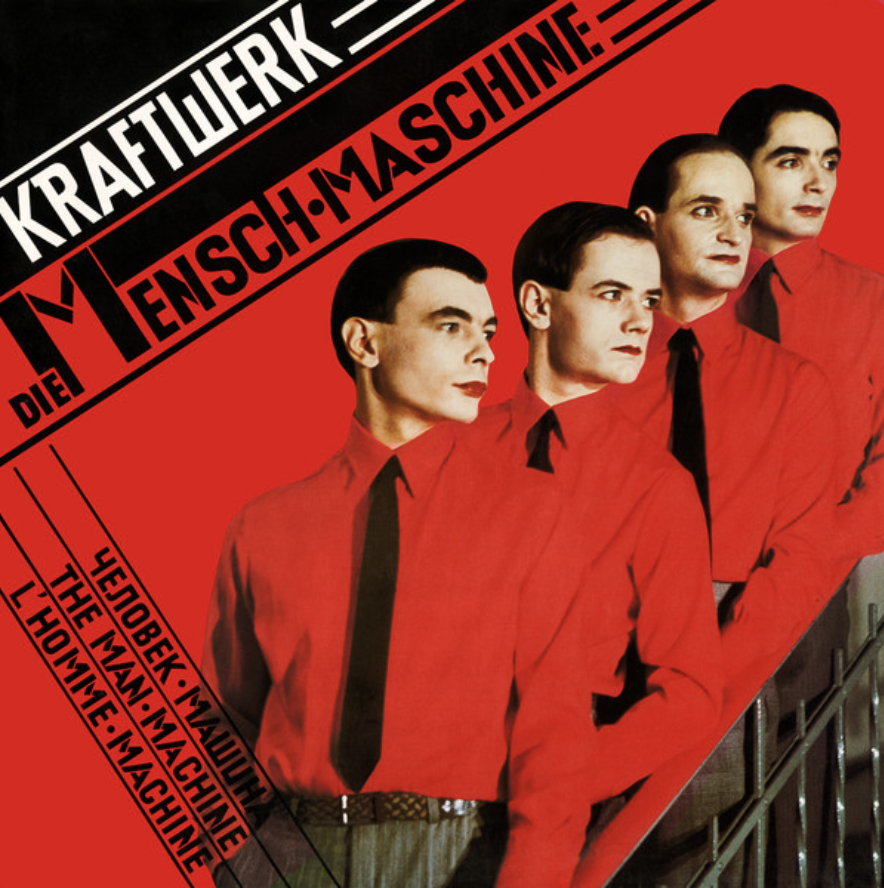
If the Beatles have had AI, they would have used it. There is little doubt that creative individuals will use these tools to create new and interesting works. In this respect, AI music as a tool cannot simply be dismissed. We could not dismiss electronic music either when, at the end of the 1970s, bands like Kraftwerk revolutionized music using “fake” instruments. Just as it would have been short-sighted to dismiss electronic music then, it would be equally short-sighted to dismiss AI music now. We will see how creatives will use AI in the next years.
5. When everything is music, music risks becoming worthless
While AI can be an instrument for creative work (it will be), it is also a tool to produce mass music of good quality. Big players like Spotify are already playing with AI music channels. This is new. And it probably will work too. One question arises: if we can produce music that is indistinguishable from what runs on the radio, and if we tend not to attribute the same value to it because it does not come from an artist with all the associated myths, then music itself in general risks becoming devalued. Please note: from a commercial point of view. Not from a personal one. We have not stopped to play chess because we are not able to beat machines anymore. As we have not stopped to learn languages because a mobile phone can translate me everything in real-time. There is values in things we do which is not monetizable.
What is possible to happen, to make a long story short, is that we may be flooded with music. All good music. All average music. Similar to all the music we listened to before AI, multiplied endlessly. This is a profound earthquake, and honestly, I don’t know yet what it will mean. I tend to believe that something will change in our perception of the value of music (also human made), when this music can be produced by a machine alone.
A small personal anecdote on devaluation
From time to time, I try to find creative ways to tell my partner that I love her. In the past, I’ve done this by many means, and they all involved some effort. A few weeks ago, I created a romantic piece of music with a meaningful text. I packaged it in a small “electronic envelope” and put it online for her to discover.
She found it nice. Two minutes. “Thank you.” And that was it.
The mere fact that something like this, even if personalized, could be produced with such ease stripped it of its symbolic value. And that realization gave me a lot to think about.
What does it mean for translation and interpreting?
Here lies the bridge to translation and interpreting. If machines can autonomously create music that is (almost) indistinguishable from human-made music — or collaborate with humans in meaningful and creative ways, as in the case of this concept album — then the implications for translation and interpreting should be clear: winning the “imitation game” and achieving outcomes that once required human-like intelligence, is possible without the need to have intelligent machines.
Creating machines that can successfully perform as translators and interpreters, much like the one-click music producers described above, is therefore not a far-fetched scenario. And my warmest advice is that people finally start to realize that this is not only possible, but it is happening. This is the only attitude to make sense (and react) to this new reality. As seen in the Alpha project, the very same technologies that can automate things can also function as tools for the professionals (or the artists) who carry out specific activities, opening up new scenarios that were unthinkable until recently. In any case, these developments will have some sort of consequences, and reasing about it in an opened and unbiased way becomes paramount.